Receiving USDT on Tron asks nothing of the receiver. Sending it does. A USDT transfer is a call to the token's contract, and Tron charges for running it in energy, and for the size of the transaction in bandwidth. An address with neither pays by burning TRX. A 402pay checkout address has only ever received USDT, so it holds no TRX to burn.
Sending from the wallet used to mean moving TRX to each address that held USDT first. It no longer does. 402pay rents the energy for the transfer, waits for it to land, sends, and adds what it paid to your fees as a network fee. This post covers what the wallet does and in what order, what the business pays and where that shows, and what happens when something along the way fails.
What a USDT send uses
Tron meters a transaction in two resources, and an address can have them in three ways: staked, rented from someone who has them, or paid for by burning TRX[1].
| Bandwidth | Points that pay for the transaction's size in bytes. Every account gets some free each day, and a new account gets that day's allowance at once. |
|---|---|
| Energy | Units that pay for running the contract. A node can run the transfer without broadcasting it and report how many it would use. A transfer to an address that has never held USDT costs about twice as much as one to a holder. |
| An account | An address the chain has no account for, such as a checkout address that has only received a token, is activated the first time it is paid in the network's own coin. Activation carries a one-time charge from the network, and the rental order covers it. |
The node's estimate is exact for the moment it was asked, and that matters below. A Tron transfer that runs short of energy does not simply fail: it reverts and still burns its fee. Our benchmark of what a payment costs to send puts figures on the energy a USDT transfer takes.
How a send used to pay
Before renting, the dashboard planned a USDT send from each address that held the coin. An address that did not hold enough TRX for the transfer's worst case was first sent the difference by the wallet's richest TRX address, and the transfer waited for that top-up to land. It worked, and it asked something of every wallet: keep some TRX on hand, in the right place. A wallet with USDT and no TRX could not send, and the dashboard said so.
That rule is common to token sends on every network, and our network fees guide explains it. On Tron, renting takes it away.
What the wallet does now
Renting is offered for token sends from a wallet created or imported in the dashboard, when the business has allowance left (more on that below). If it is on offer, the review says 402pay pays the fee, about how much, and that no TRX is needed. The send then goes in this order:
- The browser plans each transfer as a plain token transfer with no top-up, signs it, and posts it with a flag that says its energy is to be rented. The keys never leave the browser.
- The server checks the signed transfer exactly as it would any other, and refuses the flag on anything but a token send on Tron.
- Right before relaying, it asks a node how much energy this transfer needs and orders the estimate plus 1%, less what the address already has. If the address has the estimate, nothing is ordered. The order activates the account when the chain has none, and a separate small bandwidth order covers an address that is activated but short.
- It records each order and its cost, then waits, checking the chain every second and a half for about 20 seconds, until the address shows the energy the transfer needs.
- It asks the node for the estimate once more. If the token's energy cost grew while the rental landed, it orders the difference and waits again, once.
- The transfer is relayed. It burns nothing, because the energy is already on the address.


The 1% is not a safety cushion. The estimate is the node running the transfer, so it is exact, and the margin only covers the chain rounding a delegation into a unit or two less energy than was ordered. The wallet waits for the energy the transfer needs, not for the margin. A first version ordered 10% extra, far more than rounding needs.
The second estimate exists because a token's energy cost is not fixed. It is adjusted periodically, and an address with no TRX cannot burn a shortfall the way a funded one can. So the wallet checks again after the energy lands, and orders the difference if the cost grew. If the estimate keeps growing even after a top-up, the send stops with an error you can retry rather than broadcast a transfer that might revert.
One rental per send, however often it retries
A send can be attempted more than once: a dropped connection, a page reloaded, the dashboard posting the same signed transfer again under the same key. Renting has to be safe against every one of them, because every order costs money.
- Each send holds its own lock while the wallet decides what to order, so two attempts that overlap never order twice.
- A retry finds the earlier order on record. If energy has landed, nothing more is ordered. If the order is recent enough to still be landing, the retry waits for it instead of buying again.
- Each order goes to the provider under a key made from the send, and a top-up has a key of its own, so an order placed twice is answered as the first.
- What was bought stays recorded and billed whatever the relay does next, because it was paid for.
We learned the second rule from a mistake. The first version waited for the full ordered amount to show on the address. The chain rounds a delegation, so an address rented 70,713 energy showed 70,712, and the wait ran out and gave up. The retry saw an address one unit short and rented another 61,000. The fix was to wait only for the energy the transfer needs, order the margin without waiting for it, and not buy again while an earlier order is still landing.
What the business pays, and where it shows
The business pays what the rental cost 402pay: the energy, plus the account activation and the bandwidth when a send needed them. Each order is recorded in TRX, with the same amount in US dollars at the TRX price when it was ordered. 402pay passes it on at cost and earns nothing on it.
It reaches you in three places:
- In the send's review, before you sign: the fee reads about a figure instead of up to one, with a line that says 402pay pays it and adds it to your fees.
- On the send itself, recorded as its network fee.
- On your fee statement, under Settings → Payments, as a Network fee entry whose note names the amount, the coin, and Tron. The entry is written once however often the message that books it is delivered.
A network fee adds to what you owe and settles the way your other fees do, as collected from your incoming payments. It does not count toward the month's accrued payment fees, and the partners who earn a share of your payment fees earn none of it, since it is passed on and not earned.
A cap on what we will advance
402pay pays the provider first and bills you after, so each business has a rolling 30 day allowance for rentals. Once it is used up, the send goes back to burning TRX from the wallet until older rentals age out.
When something goes wrong
Renting is a convenience, never a requirement, and it is built so that failing to rent never loses or half-sends anything.
| Renting is not on offer | It may be off, the provider may be unreachable when the dashboard asks, or the allowance may be used up. The send is planned to pay in TRX with a top-up, as before, and a wallet with no TRX is told so. Asking never fails the send. |
|---|---|
| The allowance runs out between review and signing | The server refuses the send and the dashboard says 402pay cannot cover the fee any more, so it is paid in TRX. You review the new fee and send again. A plan approved as rented that is no longer offered rented, or the reverse, always goes back to review as a new fee. |
| The provider is unreachable or refuses | Nothing is relayed and the dashboard keeps the signed transfer. The same request can go again, and because it carries the same key, retrying cannot send twice. |
| The energy does not land in time | Same as above. A retry that comes soon after waits for the order already placed instead of buying another. |
| The estimate keeps growing | After one top-up the send stops with a retryable error. The transfer is not broadcast. |
The transfer goes out only when the energy is already on the address.
That rule is the reason for the wait. A Tron transfer that runs short reverts and still burns its fee, and an address with no TRX has nothing to burn. Sending early would trade a few seconds for a failed transfer.
Sending from several addresses as one transfer
Every checkout pays to its own address, so a wallet's USDT is spread across many. A send draws on the largest first, which can mean several transfers from several addresses, and the recipient sees each of them. For a Tron send that spans two or more addresses, the amount step offers Send as one transfer. It is off by default and chosen per send.
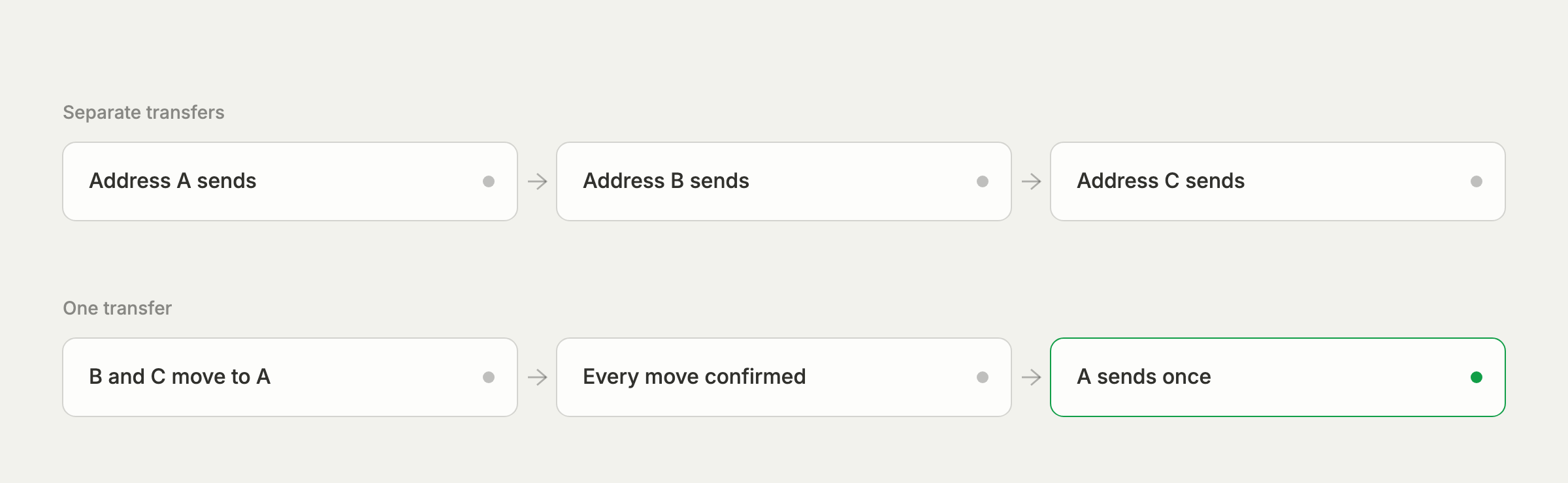
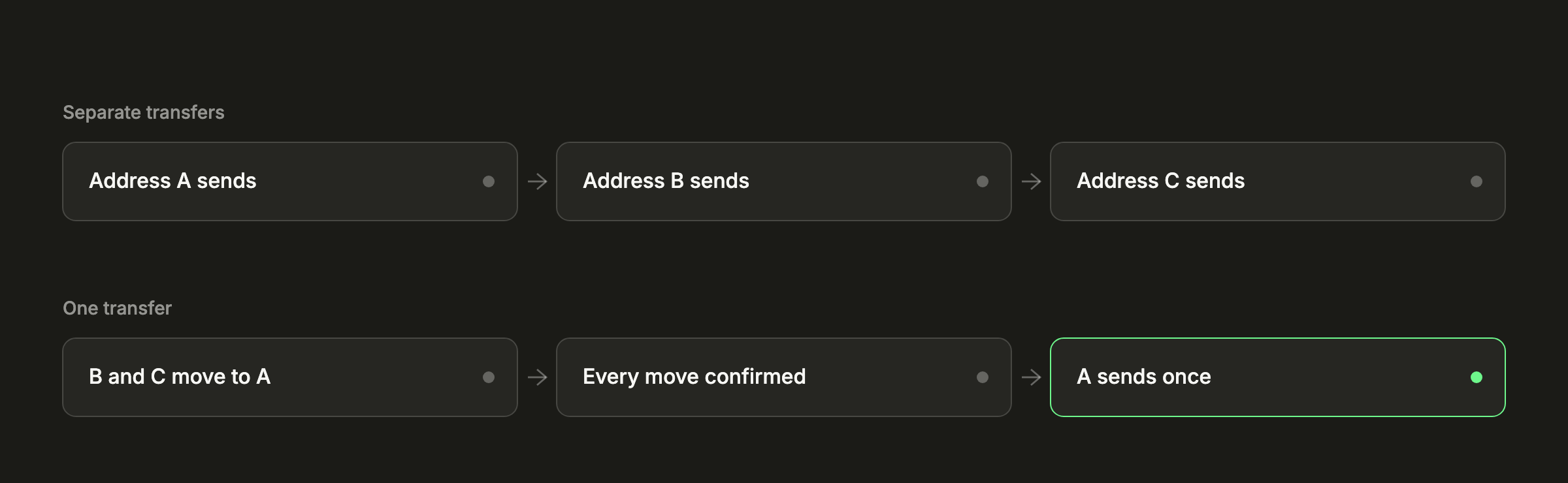
With it on, every other address first moves everything it holds into the address that holds the most, and that address makes the one transfer. All of it is signed in the browser and posted as a single request with a single key, with up to 20 moves.
- The server keeps the moves and their top-ups as steps of the one record. It relays each top-up, each move once its top-up is in a block, and the transfer only once every step is.
- Every transaction of the send shares one ten minute expiry. A step that fails on the chain, a step the network refuses once something has gone out, or the expiry passing first fails the record. Nothing went to the recipient, and what moved stays in your wallet.
- The fee is about the same as sending from each address, because it is as many token transfers and top-ups. It takes a block longer for the moves, about 3 seconds on Tron, and two longer when they need top-ups.
- Moves between your own addresses add no rows to your history.
One transfer still pays in TRX
Renting is for sends made the usual way, one transfer per address. A send made as one transfer pays its fees in TRX, with the top-ups described above, and the server refuses to combine the two.
To send, see send funds from your wallet.
Common questions
- Not when the send is offered rented energy. The review says 402pay pays the fee and adds it to your fees, and the sending address needs no TRX. When renting is not on offer, the send pays in TRX with a top-up as before.
- What it cost 402pay: the energy, plus account activation and bandwidth when the send needed them, recorded in TRX and in US dollars at the TRX price when it was ordered. It is passed on at cost.
- In the send's review as an about figure before you sign, as the transaction's network fee, and on your fee statement as a Network fee entry. It adds to what you owe and is collected like your other fees.
- Nothing is broadcast until the energy is on the address. If the provider is unreachable or the energy does not land in time, the same signed transfer can be sent again, and a retry that comes while the order is still landing waits for it instead of renting twice.
- About the same, since it is as many token transfers and top-ups as sending from each address. It takes a block or two longer for the moves, and it pays its fees in TRX rather than rented energy.
- No. Renting adds energy to the sending address. The browser builds and signs every transaction with your keys, and the server only checks and relays what you signed.
References
- [1]Paying for resources. TRON Developer Hub.
See what 402pay can do for you.
Discover how 402pay helps your business accept any card and get paid in crypto, straight to a wallet you control.