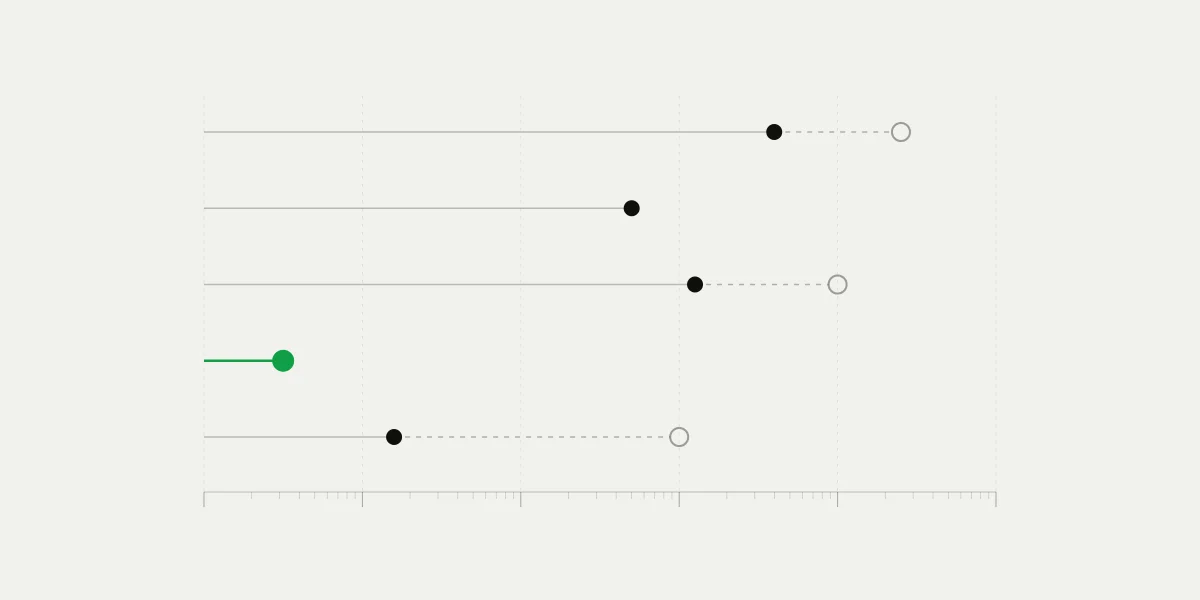
Every crypto payment pays the network that carries it, and the customer's wallet pays that fee on top of the amount it sends. On October 8, 2026, sending a payment to a new address cost from $0.0004 for LTC on Litecoin to $4.48 for USDT on Tron, more than 10,000 times as much for the same job.
- USDT on Tron$4.48
- USDT on Ethereum$0.32
- USDC on Ethereum$0.32
- USDC on Solana$0.17
- USDT on Solana$0.17
- BTC on Bitcoin$0.12
- LTC on Litecoin$0.0004
This benchmark measures that fee for the stablecoins, bitcoin, and litecoin 402pay takes, from a day of each chain's own data and each network's published fee rules, and shows why the same transfer can cost twice as much or more depending on where it's going.
What the network charges for
Each network prices a transfer by the resources it uses, in its own coin, and each counts those resources differently:
| Solana | A base fee of 5,000 lamports per signature, plus an optional priority fee priced per compute unit[1]. Paid in SOL. |
|---|---|
| Ethereum | Gas: the work a transfer takes, times a gas price that rises and falls with demand for block space[2]. Paid in ETH. |
| Tron | Energy and bandwidth. A sender can stake or rent them, or burn TRX for them at 100 sun an energy and 1,000 sun a byte[3]. |
| Bitcoin and Litecoin | A fee rate per virtual byte, set by the sender and bid against other transactions. A payment with one native SegWit input and change is about 141 vbytes[4]. |
None of these depend on the amount. A fee that is a rounding error on a large invoice can be a real share of a small order, which is where the differences below start to matter.
The cost on October 8, 2026
Here is what one payment cost to send, in the network's own coin and in dollars at that day's prices. The first column is a transfer to an address that already holds the coin; the second is one to an address that never has.
| Measure | Fee paid in | To an address that holds it | To a new address |
|---|---|---|---|
| USDC on Solana | SOL | $0.0006 (0.00000505 SOL) | $0.17 (0.001493 SOL) |
| USDC on Ethereum | ETH | $0.23 (45,160 gas) | $0.32 (62,248 gas) |
| USDT on Solana | SOL | $0.0006 (0.00000505 SOL) | $0.17 (0.001493 SOL) |
| USDT on Tron | TRX | $2.27 (6.774 TRX) | $4.48 (13.37 TRX) |
| USDT on Ethereum | ETH | $0.23 (46,109 gas) | $0.32 (63,197 gas) |
| BTC on Bitcoin | BTC | $0.12 (0.00000141 BTC) | $0.12 (0.00000141 BTC) |
| LTC on Litecoin | LTC | $0.0004 (0.00000564 LTC) | $0.0004 (0.00000564 LTC) |
Bitcoin paid about 1 satoshi a vbyte for most of the day[5], and Litecoin about 4 litoshis a vbyte[6]. Tron stands apart: its energy price is fixed by the chain rather than bid, so a USDT transfer burns the same TRX on a busy day as on a quiet one.
Why a new address costs more
On three of the five networks, the first time an address receives a token costs the sender more, because the network has to create something for it to hold the balance in:
- On Solana, a token is held in a token account of its own. If the recipient has none for that token, the transfer creates it, and whoever creates it pays a deposit to keep it open[7]. The documentation lists 2,039,280 lamports; on October 8, 2026 the network asked for 1,488,440, about $0.17. Only the account's owner can close it and reclaim the deposit.
- On Ethereum, a token balance is a slot in the token contract's storage. Writing a slot that was empty costs 20,000 gas, four times the cost of updating one that wasn't[8], so a transfer to a new holder used about 17,088 more gas in our sample.
- On Tron, the same storage write shows up as energy: every USDT transfer we sampled used either 64,285 energy or, to an address that didn't hold USDT, 130,285.
Bitcoin and Litecoin have no balances to create. A payment is a new output locked to the address, so a new address costs exactly what an old one does.
Checkout addresses are new by design. Every 402pay checkout gets an address of its own, so each payment matches its order without guesswork; the post on addresses explains why. That makes the second column the one that applies to a checkout payment.
The network fee depends on where the money goes, not how much of it there is.
How much it moves
A day's typical fee hides how much it can move within that day, and the networks differ most here.
- Ethereum's base fee in the blocks we sampled ranged from 0.1 to 5.38 gwei. At those prices, the same transfer to a new address cost from about $0.02 to about $0.86 in base fee alone, depending on the hour.
- Bitcoin's median fee rate peaked at 5 satoshis a vbyte, which put a payment at $0.59, five times the day's typical cost.
- Solana and Tron fees are fixed in their own coins, so in dollars they move only with the price of SOL and TRX, plus any priority fee a Solana wallet adds.
What it means for a checkout
The customer's wallet pays the network fee on top of what it sends, so the payment lands in the business's wallet whole, and 402pay's checkout shows an estimate of the fee beside the total. Who pays it doesn't change what it does to a small order, though. As a share of the order, the fee to a new address was:
| Measure | $10 order | $50 order | $100 order |
|---|---|---|---|
| USDT on Tron | 45% | 9% | 4.5% |
| USDT on Ethereum | 3.2% | 0.64% | 0.32% |
| USDC on Ethereum | 3.2% | 0.63% | 0.32% |
| USDC on Solana | 1.7% | 0.35% | 0.17% |
| USDT on Solana | 1.7% | 0.35% | 0.17% |
| BTC on Bitcoin | 1.2% | 0.23% | 0.12% |
| LTC on Litecoin | Under 0.01% | Under 0.01% | Under 0.01% |
USDT on Tron is the outlier, at 45% of a $10 order for a sender who burns TRX. Most senders don't: 700 of the 793 USDT transfers we sampled burned none for energy, using energy staked or rented instead, and a customer withdrawing from an exchange pays the exchange's own withdrawal fee. Litecoin stays under a cent, Solana does too until a token account has to be made, and BTC on Bitcoin cost about $0.12.
The practical answer is to offer every network your customers hold funds on, since a customer pays from where their money already is. Our guide to choosing networks covers the rest of that decision.
How we measured
Every figure is for October 8, 2026, in UTC, converted to dollars at CoinGecko's price for each coin at the start of the day[10]: SOL $116.23, ETH $2,573.23, TRX $0.3352, BTC $83,282, LTC $66.06.
- Solana: the fee on each plain USDC or USDT transfer, 57 in all, in 16 blocks spread across the day, read from a public Solana node. The median was 5,050 lamports.
- Ethereum: Etherscan's average gas price for the day[2], times the median gas of the 714 direct USDC and USDT transfers in 12 blocks two hours apart, which anyone can inspect on Etherscan[9].
- Tron: the energy, bandwidth, and TRX burned on each of the 793 successful USDT transfers in 12 blocks two hours apart, read from a public Tron node, and the chain's burn prices[3].
- Bitcoin and Litecoin: the median fee rate in each block mined that day[5, 6], applied to a 141-vbyte payment[4].
A wallet that adds a priority fee, or picks a faster fee rate, pays more than these figures; an exchange charges its own withdrawal fee instead. The figures describe the network's price, not any one wallet's.
Fees change
Network fees move by the hour and coin prices by the minute. Read these as one day's snapshot, and check a network's own fee data before planning around a number.
Common questions
- The customer's wallet, on top of the amount it sends, in the network's own coin. The payment lands in the business's wallet whole.
- On October 8, 2026, Solana, where a USDC or USDT transfer cost under a cent, or about $0.17 when it also had to create the recipient's token account.
- The network has to create a place for the new holder's balance. On Tron a USDT transfer to a new address used 130,285 energy instead of 64,285, and on Ethereum a transfer to a new holder used about 37% more gas.
- Not by itself. Network fees depend on the transfer's size in bytes, gas, or energy, not on the amount it moves, so a $10 payment and a $10,000 one sent the same way cost the same. On Bitcoin and Litecoin, a payment that has to combine many smaller coins is larger in bytes and costs more.
References
- [1]Fees on Solana. Solana Documentation.
- [2]Ethereum Average Gas Price Chart. Etherscan.
- [3]Paying for resources. TRON Developer Hub.
- [4]Transaction size calculator. Bitcoin Optech.
- [5]Block fee rates. mempool.space.
- [6]Block fee rates. litecoinspace.org.
- [7]Create a token account. Solana Documentation.
- [8]EIP-2200: Structured definitions for net gas metering. Ethereum Improvement Proposals.
- [9]USDC token tracker. Etherscan.
- [10]Bitcoin historical data. CoinGecko.
See what 402pay can do for you.
Discover how 402pay helps your business accept any card and get paid in crypto, straight to a wallet you control.