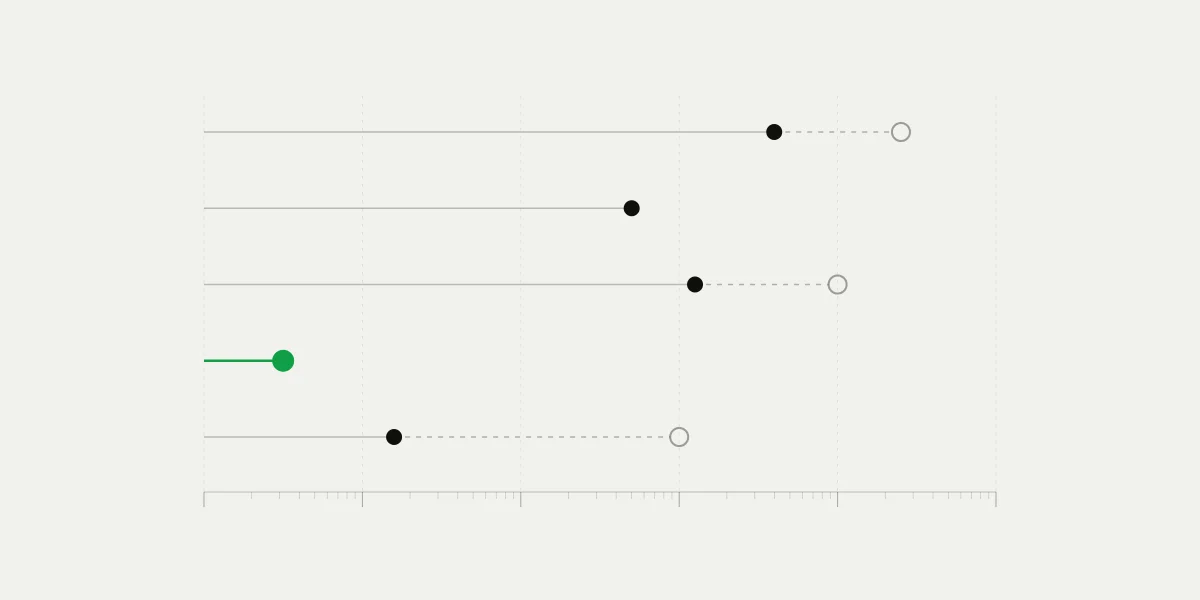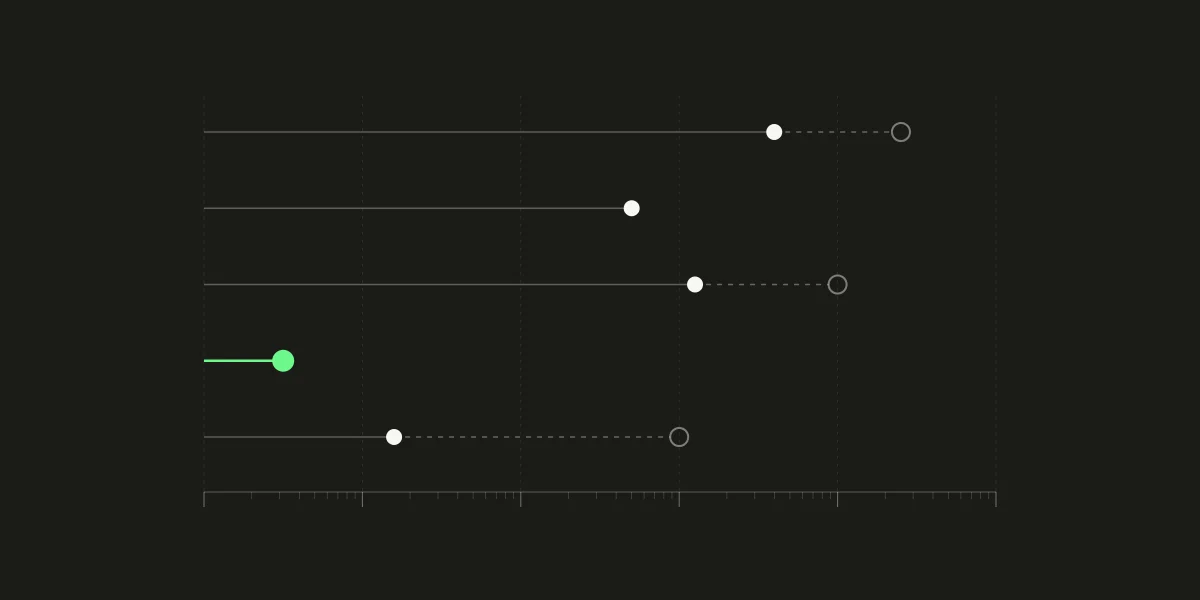
How long a crypto payment takes depends on its network. Each one adds blocks on its own schedule, and a payment is done when enough of them have landed on top of it. From September 18 to October 17, 2026, the typical wait from sending to 402pay counting a payment ran from about 8 seconds on Solana to about 6.8 minutes on Bitcoin.
- Bitcoin6.8 minutes
- Litecoin4.3 minutes
- TronAbout a minute
- Ethereum18 seconds
- Solana8 seconds
This benchmark measures that wait on every network 402pay takes, from 30 days of each chain's own blocks, and sets it beside the point each protocol calls a transaction final. The averages are only half of it: on Bitcoin, the slow cases matter more than the typical one.
Two finish lines
A payment passes two points after it's sent, and they aren't always the same moment:
| Counted | When 402pay marks the payment succeeded and sends payment.succeeded: after a set number of blocks on each network, the same for every business. |
|---|---|
| Final | When the protocol itself treats the transaction as irreversible. Some networks have an exact rule for it; on Bitcoin and Litecoin it's a matter of how many blocks an attacker would have to redo. |
On Solana and Tron, 402pay waits for the protocol's own finality, so the two are the same. On Ethereum, it counts a payment after 2 blocks and keeps watching the transfer until the network finalizes it. It counts a payment after 1 block on Bitcoin and 2 blocks on Litecoin.
Network by network
Each network's block time as designed and as measured from September 18 to October 17, 2026, and what that adds up to:
| Measure | Designed | Measured | 402pay counts it after | Typical wait | Final by protocol |
|---|---|---|---|---|---|
| Solana | 400 ms slots | 250 ms slots | Finalized block | About 8 seconds | When counted |
| Ethereum | 12 s slots | 12.05 s | 2 blocks | About 18 seconds | About 15 minutes |
| Tron | 3 s slots | 3.0 s | Solidified block | About a minute | When counted |
| Litecoin | 2.5 minutes | 2.5 minutes | 2 blocks | 4.3 minutes | No exact rule |
| Bitcoin | 10 minutes | 9.7 minutes | 1 block | 6.8 minutes | No exact rule |
The designed times come from each network's own code and documentation[1, 2, 3, 4, 5]. Every network ran close to its design, except Solana, whose slots averaged 250 ms against the 400 ms its documentation targets, which made its finality quicker, not slower.
Bitcoin: the average hides the tail
Bitcoin aims for a block every ten minutes[1], and over the window it averaged 9.7 minutes across 4,440 blocks. But blocks are found at random, so most gaps are shorter than the average and a few are much longer:
- 6.9 minutes
- Median gap between blocks
- 13%
- Of gaps longer than 20 minutes
- 68.7 minutes
- Longest gap in the window
A customer doesn't pay at the start of a block; they pay at some moment in between, and they are more likely to land in a long gap than a short one, simply because long gaps take up more of the clock. From a moment picked at random, the wait for each number of blocks was:
| Measure | Median wait | 1 in 10 waits over | 1 in 100 waits over |
|---|---|---|---|
| 1 block (402pay) | 6.8 minutes | 22.2 minutes | 41.8 minutes |
| 2 blocks | 16.3 minutes | 37.7 minutes | 61.4 minutes |
| 3 blocks | 25.9 minutes | 51.3 minutes | 77.8 minutes |
Those figures assume the transaction makes the next block, which needs a fee rate that competes. Blockchain.com's daily median time for a fee-paying transaction to reach a block, which includes the ones that waited, averaged 11 minutes over the window, from 6.9 minutes on the quickest day to 14 minutes on the slowest[8].
Bitcoin has no exact point of finality. Its developer guide says software handling high-value transactions should wait for at least six confirmations and calls the number somewhat arbitrary[6]; each block makes reversal harder. 402pay counts a payment after 1 block, keeps watching it for several more, and stops the checkout's quote clock the moment the transaction is first seen, so a slow block never makes a customer late. Our post on confirmations covers how.
On Bitcoin, plan for the slow block, not the average one.
Litecoin: four blocks in Bitcoin's time
Litecoin runs on the same design with a 2.5-minute target[2]. Over the window it averaged 2.5 minutes across 17,153 blocks, with a median gap of 1.8 minutes, only 0.04% of gaps over 20 minutes and none longer than 24.5 minutes.
402pay waits for 2 blocks there, and from a random moment that took a median of 4.3 minutes, with one customer in ten waiting more than 9.7 minutes and one in a hundred more than 16.3 minutes. Its one-in-ten case is about as long as an average Bitcoin block.
Ethereum, Tron, and Solana: seconds
The three account-based networks produce blocks on a fixed clock, so their waits barely vary. What differs is when the protocol calls a block final:
- Ethereum has a slot every 12 seconds[3], and averaged 12.05 seconds a block, with 0.43% of slots empty[9]. 402pay counts a payment after 2 blocks, about 18 seconds from a random moment. Finality takes about 15 minutes[7], and 402pay keeps watching the transfer until then.
- Tron schedules a block every 3 seconds, and a block is irreversible once 19 of its 27 block producers have built on it, typically about a minute[4]. Over the window it averaged 3.0 seconds a block, with 0.03% of slots empty. 402pay counts a Tron payment once its block is solidified.
- Solana's documentation targets 400 ms slots and puts the newest finalized block at least 32 slots behind the newest confirmed one, about 13 seconds at that target[5]. Its 10,296,228 slots over the window averaged 250 ms, which puts 32 slots at about 8 seconds. 402pay counts a payment when its block is finalized[10].
Watching past the finish line
On Ethereum, Bitcoin, and Litecoin, 402pay keeps following a transfer after it's counted. If a block holding one were ever replaced after that point, the payment stays succeeded and nothing moves on its own: the case is flagged for review.
What it means for fulfilling orders
Fulfill on payment.succeeded, on every network, and design the wait around the network rather than around an average.
- For something delivered on the spot, like a download, a top-up, or access to a stream, the payment is counted in seconds on Solana and Ethereum and in about a minute on Tron. Customers barely notice.
- On Litecoin, a few minutes is normal, and a page that says so keeps customers calm.
- On Bitcoin, a wait of 20 minutes or more happens to about one customer in ten. Tell them they can close the page, and confirm the order by email once it's paid.
Our post on how 402pay confirms a payment covers what checkout shows the customer while they wait.
How we measured
We read every block in the 30 UTC days from September 18 to October 17, 2026:
- Bitcoin and Litecoin: each block's timestamp, from public block explorers[11, 12]. Miners set timestamps loosely, so we treated each block as found no earlier than the one before it. The waits come from 200,000 moments picked at random in the window, each measured to the block after it.
- Ethereum, Tron, and Solana: the first and last block in the window and their times, from each network's public nodes. They give the average time per block or slot, and on Ethereum and Tron, how many slots had no block.
- Finality rules come from each network's own documentation, and 402pay's confirmation counts from the same configuration checkout runs on.
Networks change
Block times drift with hash rate and with protocol upgrades. Read these as one month's measurement, and check a network's own data before relying on a number.
Common questions
- 402pay counts it after 1 block. From September 18 to October 17, 2026, that took a median of 6.8 minutes from a random moment, and one payment in ten waited more than 22.2 minutes.
- Solana, where 402pay counted a payment in about 8 seconds from September 18 to October 17, 2026. Ethereum and Tron follow within about a minute.
- 402pay counts it after 2 blocks, about 18 seconds, and keeps watching it until the network finalizes it, about 15 minutes later.
- Blocks are found at random, so the gap between them varies widely around the ten-minute average. A customer is also more likely to pay during a long gap than a short one, and a transaction with a low fee can miss the next block.
References
- [1]Bitcoin Core chain parameters. Bitcoin Core.
- [2]Litecoin Core chain parameters. Litecoin Core.
- [3]Proof-of-stake (PoS). ethereum.org.
- [4]Consensus and DPoS. TRON Developer Hub.
- [5]Transaction confirmation and expiration. Solana Documentation.
- [6]Payment processing. Bitcoin Developer Guide.
- [7]Single slot finality. ethereum.org.
- [8]Median confirmation time. Blockchain.com.
- [9]Ethereum average block time chart. Etherscan.
- [10]Solana RPC methods: commitment. Solana Documentation.
- [11]Blockstream Explorer. Blockstream.
- [12]Litecoin Space. litecoinspace.org.
See what 402pay can do for you.
Discover how 402pay helps your business accept any card and get paid in crypto, straight to a wallet you control.