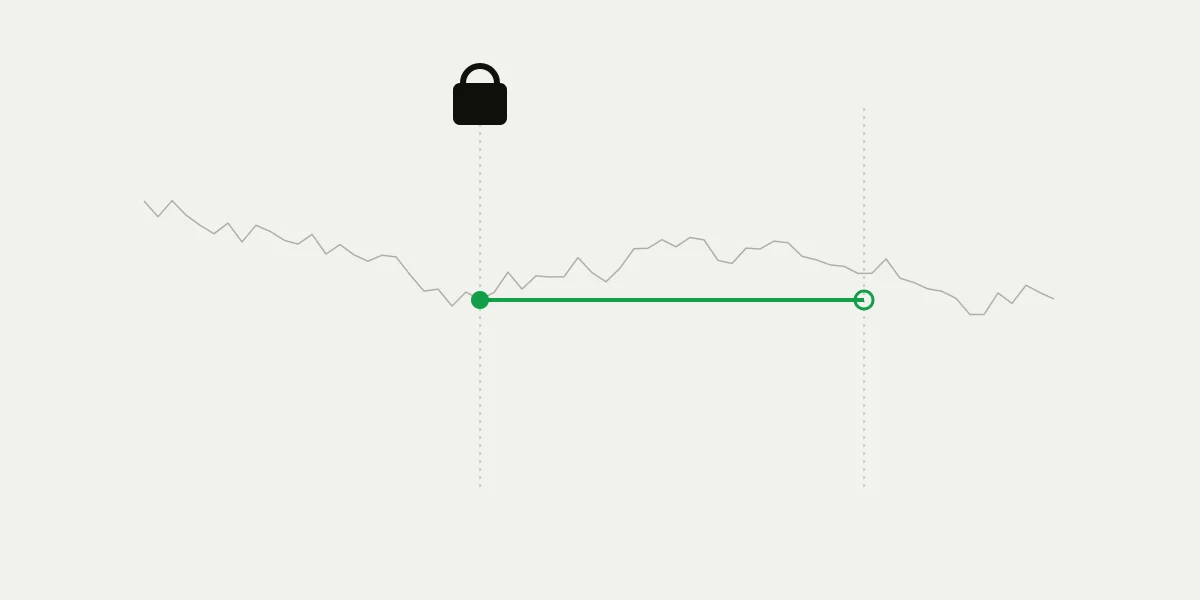
Every crypto checkout on 402pay makes the customer a promise: send this exact amount of this coin, to this address, before this time, and the order is paid. The promise is the quote, and the time limit on it is the rate lock. It exists because the price is set in dollars or euros while the payment arrives in a coin whose value moves by the minute.
This post covers how a quote is built, where its rate comes from, what is fixed once it's issued, which moment counts against the deadline, and what happens to transfers that arrive short or late. It picks up where our post on confirmations left off.
What a quote locks
A quote is created when the customer picks a coin and a network. At that moment the checkout copies everything it will later judge a transfer by, and stores it on the checkout itself:
| Coin amount | The exact amount to send, in the coin's own units. |
|---|---|
| Rate | One coin in the price's currency, as it stood when the quote was made. |
| Deadline | The rate lock from Checkout settings, 15 minutes unless changed. |
| Tolerance | How far short a transfer can be and still count as paid, 0.5% unless changed. |
| Address | A fresh deposit address that belongs to this checkout alone. |
{ "data": { "id": "chk_C5yhPQvPqpYgdDgj", "status": "open", "amount": "49.00", "currency": "USD", "crypto": { "asset": "BTC", "network": "bitcoin", "amount": "0.00049797", "rate": { "amount": "98400.00", "currency": "USD" } }, "expires_at": "2026-10-13T14:32:00.000Z" }}Copying rather than referencing is deliberate. If the business changes its rate lock, its tolerance, or a link's price while a customer is mid-payment, the open quote keeps the terms it showed. Every decision about a transfer is made against the quote it was sent to, and no later step reads a market rate again.
Where the rate comes from
Coin prices in US dollars are refreshed every few minutes from a market feed, and a separate table converts the other price currencies to dollars. Each price carries the time it was taken. A coin whose price is older than a fixed freshness limit isn't quoted at all: its options drop out of checkout until a fresh price arrives. A missing option is a better failure than a stale quote, because the customer can still pick another coin, and nobody pays at a rate that no longer exists.
There is no spread or buffer added to the amount. The quote is a straight conversion of the price at the current rate, which keeps it predictable for the business and easy to check for the customer. Stablecoins are converted the same way, at their market price rather than an assumed one-to-one, so a quote in USDC or USDT reflects the coin's actual value at that moment.
Working out the amount
The arithmetic is short and runs in the same order for every quote:
- Convert the price to US dollars at the currency table's rate, rounded to the cent.
- Add 402pay's fee if the business has customers pay the fees, worked out on the price, never on a total that already includes it.
- Divide by the coin's price and round to the coin's quote precision.
A $49 price paid in Bitcoin, at an example price of $98,400.00 a coin, is 0.00049797 BTC. Quote precision is set per coin so the last digit is still worth something without asking a customer to type a dozen decimals: 2 places for USDC, 6 places for ETH, 4 places for SOL, and 8 places for BTC.
The network fee isn't in the quote
The customer's wallet pays the network on top of the amount sent, in the network's own coin. Checkout shows an estimate beside the total so the customer isn't surprised, but the quote asks only for what should arrive. See network fees.
Which moment counts
A deadline needs a clock, and a crypto transfer has several candidate moments: when the customer pressed send, when the transfer reached the network, when it was confirmed, and when our systems processed it. We judge the deadline by the time the network records for the transfer.
That choice has two consequences worth knowing. First, confirmations don't race the clock. Once a transfer covering the amount has arrived in time, the checkout moves to confirming and can no longer expire, so a Bitcoin payment that needs a block or two still completes at the quoted rate. Second, our own processing delay never counts against the customer. If a background sweep closes a quote at its deadline and the notice of a transfer that arrived just before it is processed a moment later, the quote is reopened and the payment proceeds as if nothing happened.


The customer is judged on when they paid, never on how fast we noticed.
Changing coins mid-checkout
Customers often step back: they pick USDC on Ethereum, notice the network fee, and switch to USDC on Solana. Each choice is its own quote with its own address. Going back to a choice made a moment ago returns the same quote, address and amount included, as long as it still has a couple of minutes left, so a customer who flips between options doesn't collect a trail of addresses.
A quote the customer stepped away from is still watched until its own deadline. If a transfer lands on it after all, that quote is the one that gets paid, the newer one closes, and the checkout page follows the quote that received the money. Whichever address the customer actually used, the payment is matched.
What expiry does
When the deadline passes with nothing sent, the checkout expires. What that means for the payment depends on where it came from:
- A payment link's payment lasts as long as its quote. It expires with it, and
payment.expiredfires. A customer who opens the link again starts a new payment. - A payment created through the API has a lifetime of its own, set by
expires_at. The quote expires, but the payment stays pending, and the checkout offers the customer a new quote at the current price until the payment itself runs out.
An underpaid quote behaves differently. When a transfer arrives short by more than the tolerance, the clock restarts for the rest: the customer gets a fresh window to send the remainder to the same address at the same rate. If that window also runs out, the payment stays underpaid rather than expiring, and the business decides. It can accept what arrived, or request the remainder, which creates a new checkout for exactly the amount still owed, priced at the current rate and with no second fee. Our post on underpayments covers both.
Late transfers
Some customers pay after the deadline anyway, usually because an exchange held the withdrawal for a while. The money is real and it's already in the business's wallet, so the address stays watched after expiry. A transfer that lands on an expired quote moves the payment to needs review, with the reason late, and fires payment.needs_review.
We don't resolve a late transfer automatically, in either direction. Counting it as paid would give the customer an old rate the business never agreed to extend; refusing it would leave the customer's money unaccounted for. The payment records what arrived, valued at the quote it was sent against, and the business accepts it as paid or sends it back. See payments that need review.
Choosing a lock length
The rate lock is a business-wide setting under Settings → Checkout: 5, 10, 15, 30, and 60 minutes, with 15 as the default. An API payment's expires_at controls how long the payment accepts new quotes, not how long each quote lasts. Picking a length is a trade between two costs:
| Shorter | Less exposure to price movement on volatile coins, but more customers who run out of time and need a new quote. |
|---|---|
| Longer | Room for customers paying from an exchange, which can take a while to release a withdrawal, but more movement on coins like Bitcoin and Ether. |
For a business that mostly receives stablecoins, a longer lock costs almost nothing, since the rate barely moves. If the payments list shows a steady trickle of late transfers, the lock is probably too short for how your customers pay. Because the deadline is judged by when a transfer arrives, slow confirmations are never a reason to lengthen it.
Common questions
- 15 minutes by default. A business can set its rate lock to 5, 10, 15, 30, and 60 minutes in its checkout settings.
- No. The coin amount is a straight conversion of the price at the current market rate, rounded to the coin's quote precision.
- It still counts at the quoted rate. The deadline is judged by when the transfer reaches the network, and once it has arrived in time the checkout can no longer expire.
- The money still lands in the business's wallet, and the payment moves to needs review. The business accepts it as paid or sends it back.
- No. The customer's wallet pays the network fee on top of the quoted amount, in the network's own coin.
See what 402pay can do for you.
Discover how 402pay helps your business accept any card and get paid in crypto, straight to a wallet you control.